Monday, March 12, 2012

Tablet wars reloaded: Apple iPad 3 vs Samsung Galaxy Note 10.1 vs ASUS Transformer Pad Infinity TF700T

Apple just unveiled its latest slate and one of questions you are probably asking yourselves is, “How does it compare to its market rivals?”. That’s why we decided to create a table, comparing the iPad 3 to what are currently two of the hottest slates out there – the Asus Transformer Pad Infinity TF700T and the Samsung Galaxy Note 10.1.
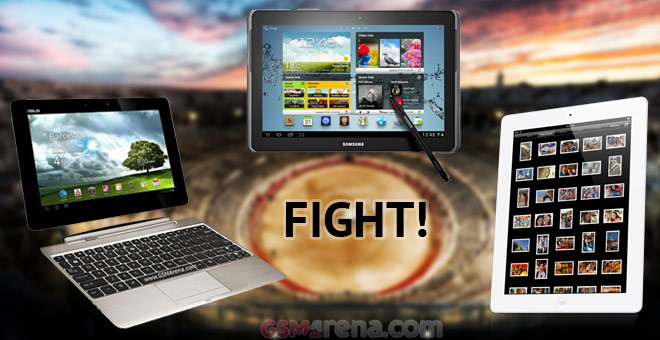
Now lets see if those brave Android tablet warriors will be able to take the smug smile off of the iPad 3′s Retina display.
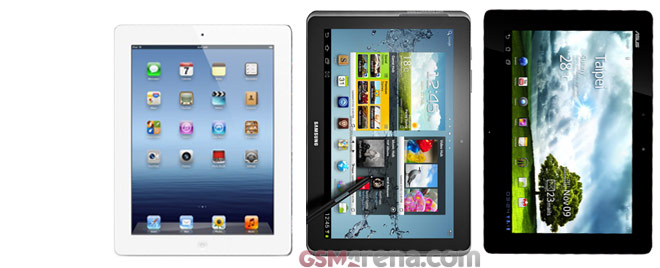
 
APPLE IPAD 3 (HD)
SAMSUNG GALAXY
NOTE 10.1
ASUS TRANSFORMER PAD INFINITY 700
OS
Apple iOS 5.1
Android 4.0
Ice Cream Sandwich
Android 4.0
Ice Cream Sandwich
Display
9.7-inch
IPS TFT
10.1-inch
PLS TFT
10.1-inch
Super IPS+ LCD
Resolution
2048 x 1536 pixels
1280 x 800 pixels
1920 x 1200 pixels
Height
241.2 mm
256.7 mm
263 mm
Width
185.7 mm
175.3 mm
180.8 mm
Thickness
9.4 mm
8.9 mm
8.5 mm
Weight
652 grams
(Wi-Fi)
662 grams
(Wi-Fi + 4G)
583 grams
586 grams
Processor
1GHz
dual-core
Cortex A9
1.4GHz
dual-core
Cortex-A9
1.6 GHz
quad-core
Cortex-A9
1.5GHz
dual-core
Krait
GPU
Quad-core
PowerVR SGX543MP4
Mali-400MP
Twelve-core
ULP GeForce
Adreno 225
Storage
• 16GB
• 32GB
• 64GB
• 16GB
• 32GB
• 64GB
• 32GB
• 64GB
microSD
No
Yes, up to 32GB
Yes, up to 32GB
RAM
? GB
1GB
1GB
Main camera
5MP Auto-Focus
(1080p)
3.15 MP Auto-Focus with
LED Flash (1080p)
8MP Auto-Focus with
LED Flash (1080p)
Main camera
Features
• Geo-tagging
• Face detection
• Geo-tagging
• Geo-tagging
Front-facing camera
Yes, VGA
Yes, 2MP (720p)
Yes, 2MP (720p)
Wi-Fi
802.11 a/b/g/n
802.11 a/b/g/n
802.11 a/b/g/n
USB
Proprietary connector
microUSB port
Bluetooth
Yes, v4.0 with A2DP, LE
Yes, v3.0 with A2DP
Yes, v4.0 with A2DP, LE
Battery
42,5Wh
25,9Wh
25Wh
Network
• 2G Network
GSM 850 / 900 / 1800 / 1900
• 3G Network
HSDPA 850 / 900 / 1900 / 2100
• 4G Network
LTE 700 MHz Class 17 / 1700 / 2100
• 2G Network
GSM 850 / 900 / 1800 / 1900
• 3G Network
HSDPA 850 / 900 / 1900 / 2100
N/A
• 2G Network
GSM 850 / 900 / 1800 / 1900
• 3G Network
HSDPA
• 4G Network
LTE
Misc
S Pen
 Optional mobile dock with standard QWERTY keyboard and trackpad
Availability
16 March
(U.S., Canada, UK, France, Germany, Switzerland, Japan)
Q2
Q2
Sensors
• Accelerometer
• Gyroscope
• Proximity
• Compass
• Accelerometer
• Gyroscope
• Proximity
• Compass
• Accelerometer
• Gyroscope
• Proximity
• Compass
So, based purely on the spec sheet alone, which one would you take home with you?
Source : GSM arena


Sony Xperia S vs. Samsung Galaxy S II


Introduction

Released nearly a year apart, the Sony Xperia S and the Samsung Galaxy S II are not that different - both are flagship droids with dual-core CPUs and 4.3" screens. But the newer Xperia S brings some fine upgrades, like the 12MP camera and the 720p screen.
Still, the Galaxy S II is the outgoing Samsung flagship while the Xperia S is the best and the brightest of Sony's new NXT series and will be for a while longer, so it will have to fight off the onslaught of quad-core droids headed to market.
Processor aside, the Sony Xperia S brings a high-pixel-density 4.3" screen with 720p resolution and Mobile BRAVIA engine. Then there's the 12MP camera with 1080p video recording, a notable advantage as most new recently announced phones use 8MP shooters. There's also excellent connectivity and so on.
The 1.5GHz dual-core CPU and Adreno 220 GPU showed promising performance, beating most dual-cores too. Here's the summary of the pros and cons of going for the Sony Xperia S.

Sony Xperia S over Samsung Galaxy S II:

  • 4.3" 720p screen (342ppi) over 4.3" WVGA screen (217ppi)
  • 12MP still camera over 8MP
  • 1.5GHz Scorpion CPU over 1.2GHz Cortex-A9 CPU
  • Standard microHDMI port over MHL port (requires adapter for HDMI out)
  • GLONASS support in addition to A-GPS
  • All units have NFC over optional support in the S II
  • 1750mAh battery over 1650mAh
  • 3D sweep panorama and Multi Angle modes

Samsung Galaxy S II over Sony Xperia S:

  • SuperAMOLED Plus screen has excellent black levels and better viewing angles
  • Expandable storage, 16GB/32GB built-in over 32GB fixed storage
  • 8.5mm thick (with some thicker areas) over 10.6mm (with thinner areas)
  • Weighs 116g over 144g
  • Bluetooth 3.0+HS over Bluetooth 2.1
  • 2MP front-facing camera over 1.3MP front-facing camera
Both phones have features that we wish the other had, so there's no clear winner. Also, we'll be doing thorough testing too match the performance in seemingly equal areas (e.g. 1080p video capture) and also if the differences change the end user-experience (1.5GHz CPU vs. 1.2GHz, 1750mAh battery over 1650mAh and so on).
You should already be familiar with the structure of these head to head articles - we'll start off with a general comparison and then dig into the specifics, like screens, cameras, battery life and so on.


Sunday, February 26, 2012

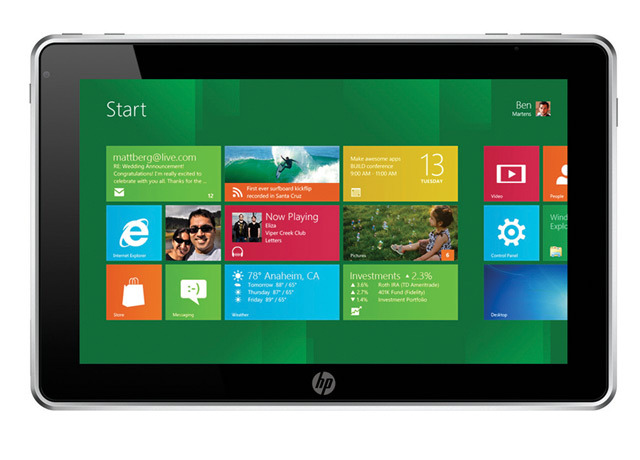
HP reportedly planning Windows 8 tablets using Intel and Qualcomm processors

hp windows 8 tablet
HP CEO Meg Whitman recently told investors that the company will be shipping Windows 8 products by the end of the year, and now CNET is reporting some possible details about its tablet plans. According to the site, HP is working on at least three different Windows 8 tablets, powered by chips from Intel and Qualcomm. The two Intel models are said to utilize the chipmaker's 32nm Atom Clover Trail platform, and will come in two distinct form factors. The first is reportedly a laptop / tablet hybrid — a device type that some of HP's competitors believe in — while the second is a more traditional tablet aimed at business customers. The third product is said to be powered by a Qualcomm processor, though no additional details are given. CNET reports that some of the three models are already being readied for commercial production, which lines up with Whitman's statements last year that the company would ship Windows 8 tablets by the end of 2012.
Whitman previously outlined the dual-pronged strategy in an interview with CRN earlier this month, noting that the company would move forward with x86 tablets first, because "we don't know when the delivery is for the software on an ARM chip." Tablets certainly haven't been the friendliest game for HP, with the company's Slate 500 and Slate 2 failing to impress, to say nothing of the fire-sale special HP TouchPad. Still, it's clear Whitman feels HP must be competitive in the tablet market, and is counting on Windows 8 to help it get there

Synaptics and others to support Nvidia DirectTouch for improved touchscreen performance

Nvidia DirectTouch
We all know the pain of a laggy touchscreen experience, and Nvidia is working on a solution with its DirectTouch architecture that uses a Tegra 3 chip to process touch input. The technology was originally announced at CES this year, but now it looks like we're closer to seeing DirectTouch make its way into a future tablet or smartphone, as touch controller companies Synaptics, Cypress, Atmel, N-Trig, Raydium, and Focaltech have jumped on board to build controllers that support the technology.
DirectTouch offloads some touch processing onto a low-power fifth core on the Tegra 3 chip, unlike current touchscreens which have a discrete module that accomplishes the task. Nvidia's solution hands off the touch processing duties to the primary cores of the Tegra 3 when CPU-intensive programs are being used on the device. According to Nvidia, the technology will result in improved touch performance — especially with multiple finger inputs — because the Tegra 3 is far more powerful than traditional touch controllers. It's also supposed to simplify the internal design and increase the battery life of devices that use the technology, since there's no discrete touch module taking up space and constantly consuming energy. We haven't yet played with a DirectTouch-enabled device — we hope to see one at MWC this week — but if the video below is any indication, the improvements look promising.


The father of pinball games, Steve Kordek, passes away at 100

Pinball Machine Flipper Flickr

Engineer and game creator Steve Kordek — who almost single-handedly invented what we think of as the modern pinball game — passed away Sunday at the age of 100 at his home in Park Ridge, Illinois. Pinball gaming was an evolution of what was 70 years ago called a "pin game": a user would release a ball, and then try to navigate it through a forest of pins to reach the goal at the end. Several other manufacturers tried to modify the games with an array of mechanical flippers, but it was Kordek who created a version with two flippers placed at the end of the tilted playing field in 1948. Kordek's version quickly took off, and the pinball game was born. Kordek also took the step of powering his flippers with DC current, providing them greater power and bounce, rather than the AC current used by other models.
Though he was employed by gaming company Genco at the time of his dual-flipper invention, Kordek later moved on to work for Bally Manufacturing and Williams Manufacturing, where he created games like Space Mission and Grand Prix. With the clink and clang of pinball ingrained in our collective cultural awareness as deeply as any other form of entertainment, it's safe to say Kordek has left a lasting impression. We've included some videos of Steve Kordek-designed pinball games below.


Share

Twitter Delicious Facebook Digg Stumbleupon Favorites More